What Does Modern Attendance Management Mean Today?
Attendance is a core academic record. But in higher education today, it has become much more than a compliance activity.
Colleges and universities manage attendance across programs, departments, semesters, sections, courses, labs, and academic sessions. A single paper register or disconnected spreadsheet is no longer enough to support this complexity.
A modern attendance management system should help institutions:
Record attendance accurately
Reduce faculty workload
Validate attendance securely
Track student-wise attendance patterns
Give students visibility into their own attendance
Generate reports for academic teams
Identify low-attendance students early
India’s higher education ecosystem includes 1,168 universities/university-level institutions, 45,473 colleges, and 12,002 standalone institutions registered in AISHE 2021–22. Total enrolment reached nearly 4.33 crore students in the same period.
At this scale, attendance management cannot remain a manual or delayed process.
Why Traditional Attendance Tracking Breaks Down
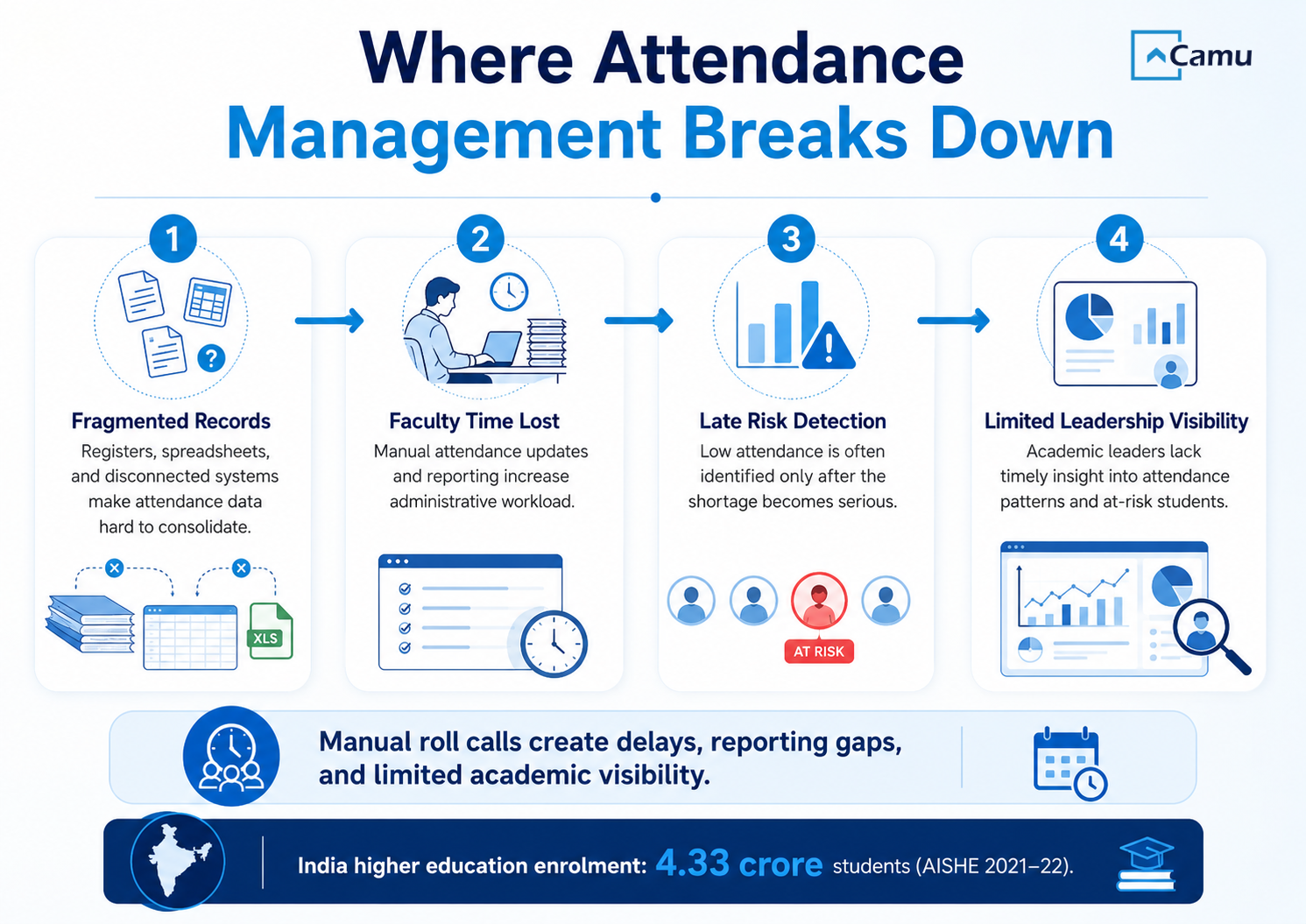
Manual attendance may work inside one classroom. But at an institutional level, it creates four major problems.
Attendance Records Become Fragmented
Many institutions still depend on registers, spreadsheets, or department-level records. This makes attendance data difficult to consolidate.
Faculty Lose Time on Administrative Work
Faculty should spend more time teaching and supporting students, not managing repeated attendance entries and reports. When attendance is marked manually, faculty may need to update registers, consolidate data, correct errors, and share reports separately with administrators.
Low Attendance Is Often Identified Too Late
Attendance is one of the earliest signs of student disengagement. When a student stops attending regularly, the issue may not be noticed until the shortage becomes serious.
Leadership Lacks Real-Time Visibility
Academic leaders need to know where participation is declining. They need answers to questions such as:
Which students are below the attendance threshold?
Which courses have irregular participation?
Which departments need follow-up?
Which students need timely intervention?
Without a connected attendance system, these questions take too long to answer.
How Camu Helps Faculty Capture Attendance with Academic Context
Camu helps faculty record attendance within the right academic structure. Before recording attendance, faculty can select:
Institution
Degree
Program
Academic year
Department
Semester
Section
Attendance date
This matters because attendance in higher education is not a flat classroom activity. It is connected to the academic structure.
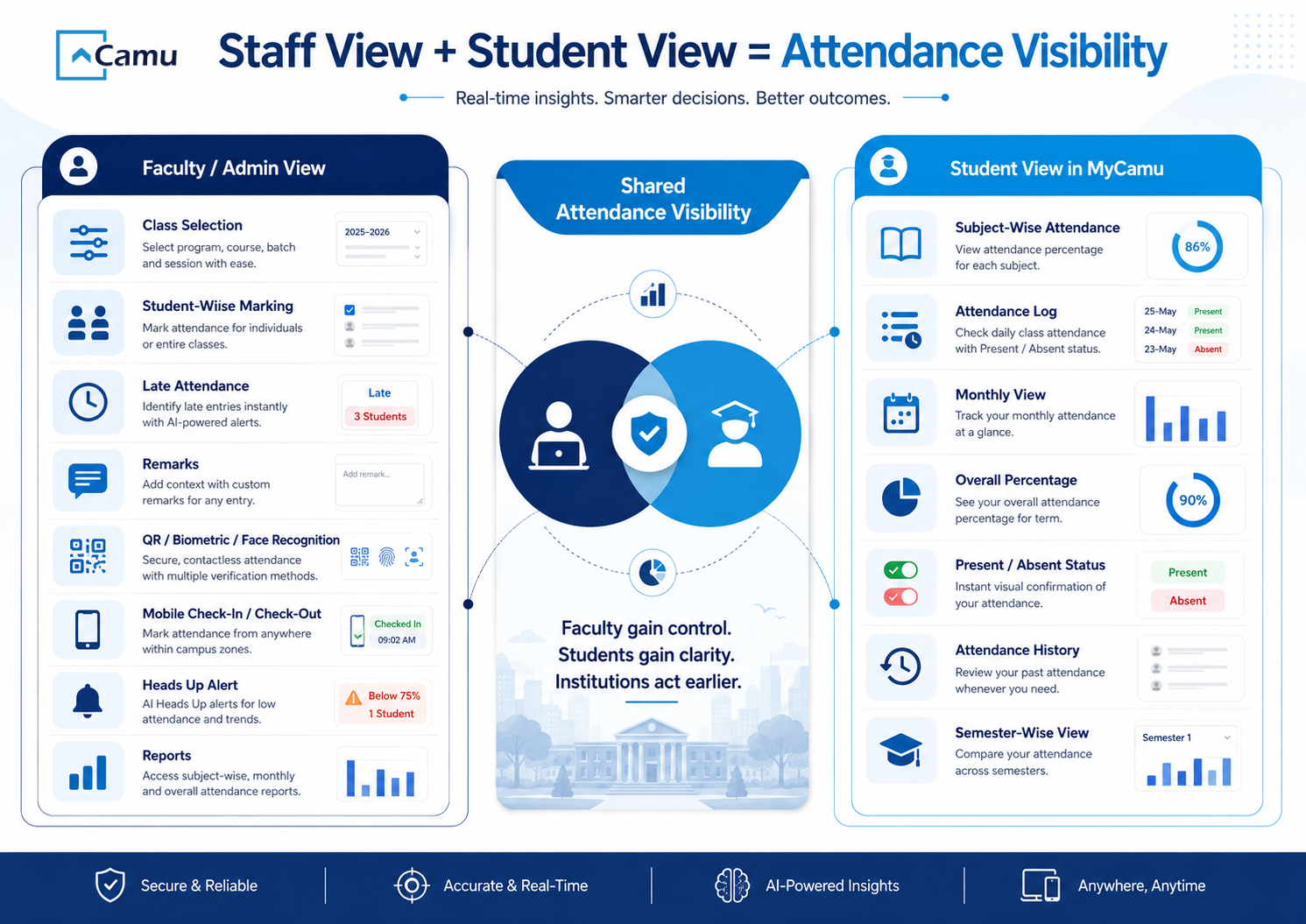
Once the class is selected, faculty can view the student list and record attendance student-wise. The interface supports search, sorting by roll number or name, late attendance, attendance remarks, and all-absent marking.
This reduces classroom-level friction and gives faculty a faster way to manage attendance.
How Camu Supports Flexible Attendance Capture
Modern campuses need more than one attendance method. Camu supports flexible attendance capture through:
QR Code Attendance
Faculty can generate a QR code for a specific class session. Students scan the QR code to record attendance. The dynamic QR code refreshes periodically, reducing misuse and helping institutions capture attendance securely.
Biometric Attendance
Biometric attendance helps institutions validate identity and reduce proxy attendance. This is useful for institutions that need stricter attendance verification.
Mobile App Check-in / Check-out
Students and faculty can mark attendance through the Camu mobile app. This supports flexible attendance workflows across campus activities.
Face Recognition Attendance
Camu also supports face recognition-based attendance capture, which adds another layer of identity-based attendance verification, especially for institutions looking to reduce manual marking and proxy attendance risks.
How Students Gain Attendance Visibility in MyCamu
Attendance visibility should not only be available to faculty and administrators. Students also need to know where they stand. Through MyCamu, students can view their attendance across different formats, including:
Subject-wise attendance
Attendance log
Monthly attendance
Overall attendance
Present and absent status
Attendance percentage
Semester-wise attendance view
This helps students understand their own attendance position without waiting for manual updates from faculty or the academic office. When students can see their attendance percentage regularly, they can act earlier. They know which subject needs attention. They know whether they are close to a shortage. They know where they need to improve consistency.
How Camu Moves Attendance from Recording to Intelligence
The most important shift is not from paper to digital. It is from recording attendance to acting on attendance data.
Camu supports this through Heads Up by Camu AI.
In the faculty attendance view, the Heads-Up alert highlights students who are falling below the recommended attendance threshold. For example, it can show that a student is below the 75% attendance threshold and needs attention.
This helps faculty and administrators identify risk earlier. Instead of waiting for a final shortage report, institutions can act while there is still time to support the student.
What Institutions Should Look for in Attendance Management Software
Features
Explanation
Academic-context filters
Tracks attendance by program, department, semester, and section
Student-wise attendance capture
Improves class-level accuracy
QR attendance
Supports faster and more secure attendance capture
Biometric attendance
Helps reduce proxy attendance
Mobile check-in/check-out
Supports flexible campus workflows
AI-based alerts
Identifies low-attendance students earlier
Student attendance visibility
Helps students track their own attendance
Dashboards and reports
Supports administrators and academic leadership
ERP integration
Connects attendance with broader academic workflows
Face recognition attendance
Enables identity-based attendance capture with less manual effort
Build Smarter Attendance Management with Camu
Manual registers, fragmented records, and delayed attendance reports should not define your academic operations.
With Camu, institutions can digitize attendance capture, support QR and biometric attendance, enable mobile check-in/check-out, give students attendance visibility, and use Heads Up alerts to identify attendance risks earlier.
Move from digital roll calls to real-time attendance intelligence with Camu.
Book a demo today.
Need Help Growing Your Business Online?
Discover expert digital solutions, guidance, and support tailored for your business goals.
What is an attendance management system in higher education?
An attendance management system helps colleges and universities record, track, validate, and report student attendance across programs, departments, semesters, sections, and class sessions.
Why do institutions need digital attendance management?
Institutions need digital attendance management to reduce manual work, improve accuracy, generate faster reports, and identify students with irregular attendance patterns earlier.
How does QR code attendance work?
QR code attendance allows faculty to generate a QR code for a class session. Students scan the code to mark attendance digitally. Dynamic QR refresh can help reduce misuse.
How does biometric attendance help institutions?
Biometric attendance validates student identity and helps reduce attendance. It is useful when institutions need stronger attendance verification.
How does Camu AI support attendance management?
Camu AI supports attendance management through Heads Up alerts that highlight students falling below recommended attendance thresholds. This helps faculty and administrators act earlier.
How can students view their attendance in MyCamu?
Students can view subject-wise attendance, attendance logs, monthly attendance, overall attendance percentage, and present or absent status in MyCamu.