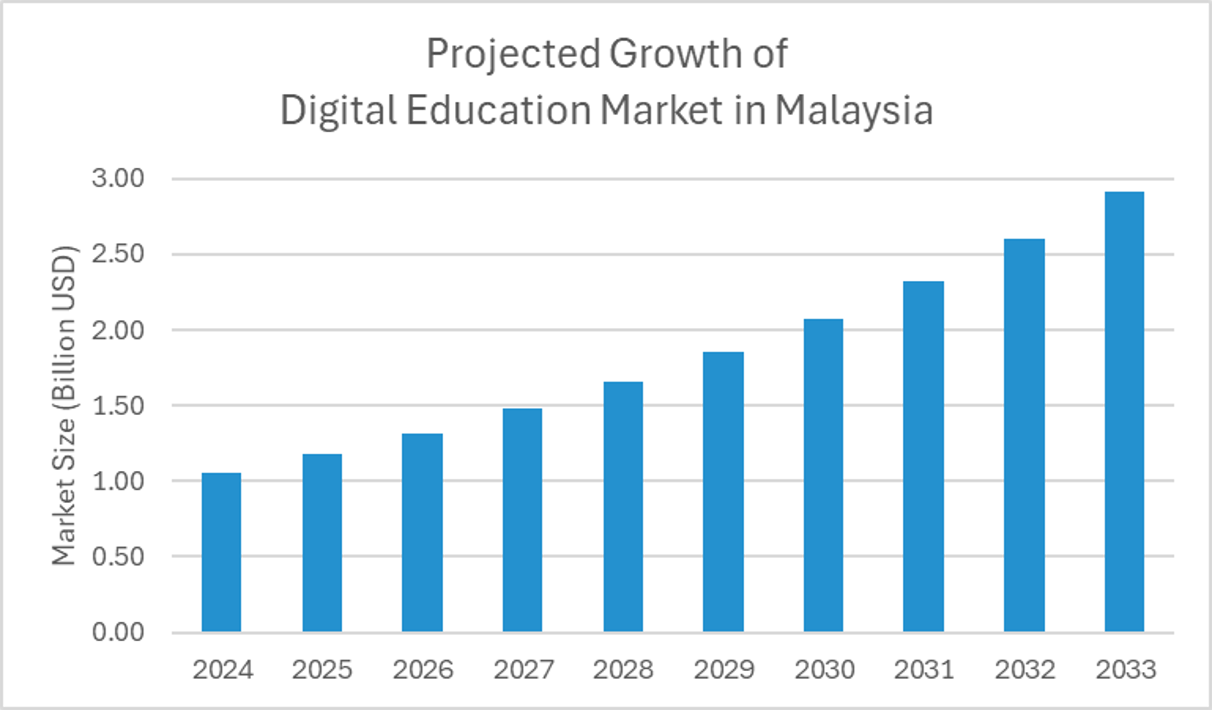
Digital Education in Malaysia has reached $1.05 billion in 2024. Nearly 12% annual growth is predicted to make it worth $3 billion by 2033.
More than 70% of colleges and universities provide digital learning. Malaysian universities are devoted to embracing modern technology in education, with 75% using AI-powered learning tools.
Online learning in Malaysia is expanding beyond schools and universities. More folks are improving their employment, advancing their careers, and studying online. The number of end users is expanding beyond schools. It now includes working adults and lifelong learners. With the rise of online learning platforms, micro-credentialing, and AI-powered learning technologies.
When combined, these signs imply digital schooling is rising. Building infrastructure, improving digital access, securing more public and private funding, and a growing number of users make it possible.
Changing Teacher Role
With this development and digital impetus, Malaysian educators and anyone dealing with Malaysian students must adapt swiftly.
Moving from traditional to hybrid/digital classrooms
More classes will likely combine offline and online learning as institutions and households adopt computer and internet infrastructure.
Data and AI provide personalization and efficiency.
As digital adoption methods are available to track student performance, learning rate, and engagement. Teachers should be ready to leverage analytics and AI tools for individualized education, targeted interventions, and time management to focus on pedagogy and student engagement.
Consider other evaluation and feedback mechanisms
Digital learning technologies enable new student assessment methods. Teachers can employ adaptive evaluations, digital portfolios, and formative feedback instead of exams. Educators must provide evaluations that demonstrate understanding and prevent digital usage.
Digital platforms enhance professional growth and collaboration.
Educators can work with peers and outside specialists as the field grows. Students should take digital-pedagogy courses, upskill, and help develop platforms.
See How Institutions Scaleup With Camu
Streamline admissions, academics, and administration with a smart,
scalable Student Information System.
Digital classrooms are limitless. Students from different socioeconomic backgrounds study together. They may be from different nations and cultures. Educators must recognize and actively close equitable disparities.
Improve industry and real-world links
Education is increasingly related to industrial needs as platforms are used. Teachers must progressively introduce students to real-world case studies, actual projects, realistic datasets, and industry-based problem-solving scenarios. Teachers should build industry relationships to guide students.
Promote responsible digital adoption
They must teach students how to use AI technologies for learning support, not to circumvent thinking or undermine assessment objectives. Academic integrity, data privacy, and online activity should be clearly defined. Technology should aid learning and comprehension. It shouldn't replace professors or dull kids' curiosity.
Create content and platform design
Many platforms now consult teachers on curriculum, assessments, and material. Teachers can create digital assets, try new options, and share usability and learning impact reviews. This lets teachers define how technology supports learning rather than adjusting to technologies not meant for classrooms.
Future for Teachers
Classrooms are going digital. Government calculated and internet boost the sector. Digitalization will be valuable if educators are moving towards to it and use technology thoughtfully. Teachers must curate learning, guide technology use, and contribute to Malaysia's digital journey.
Camu helps institutions and educators adopt digital tools intelligently and successfully.
Frequently Asked Questions
Why is digital education adoption accelerating across Malaysian institutions?
Strong infrastructure investment, AI-enabled learning platforms, and flexible online access are enabling institutions to scale digital and hybrid education efficiently.
How widely is digital learning adopted by higher-education institutions in Malaysia?
More than 70% of colleges and universities offer digital learning programs, with 75% using AI-powered learning tools to enhance personalization and engagement.
Why is online learning increasingly popular among working
professionals?
Digital platforms allow working adults to upskill, earn micro-credentials, and balance education with employment through flexible, self-paced learning models.
How is the role of teachers changing in digital and hybrid classrooms?
Educators are shifting from content delivery to learning facilitation, using analytics and AI insights to personalize instruction and improve student outcomes.
How does data-driven personalization improve learning effectiveness?
Institutions using analytics-driven learning models report higher engagement levels and improved completion rates, as interventions are targeted based on individual learning behavior.
Why is responsible AI and digital usage important in modern classrooms?
Clear guidelines ensure technology supports critical thinking, protects data privacy, and maintains academic integrity while enhancing learning experiences.